AI Shaming Is Silencing Wellness Pros — Sara Sherman on Building an AI Operating System
🎧 Prefer to listen? Play the audio version below:
About this episode:
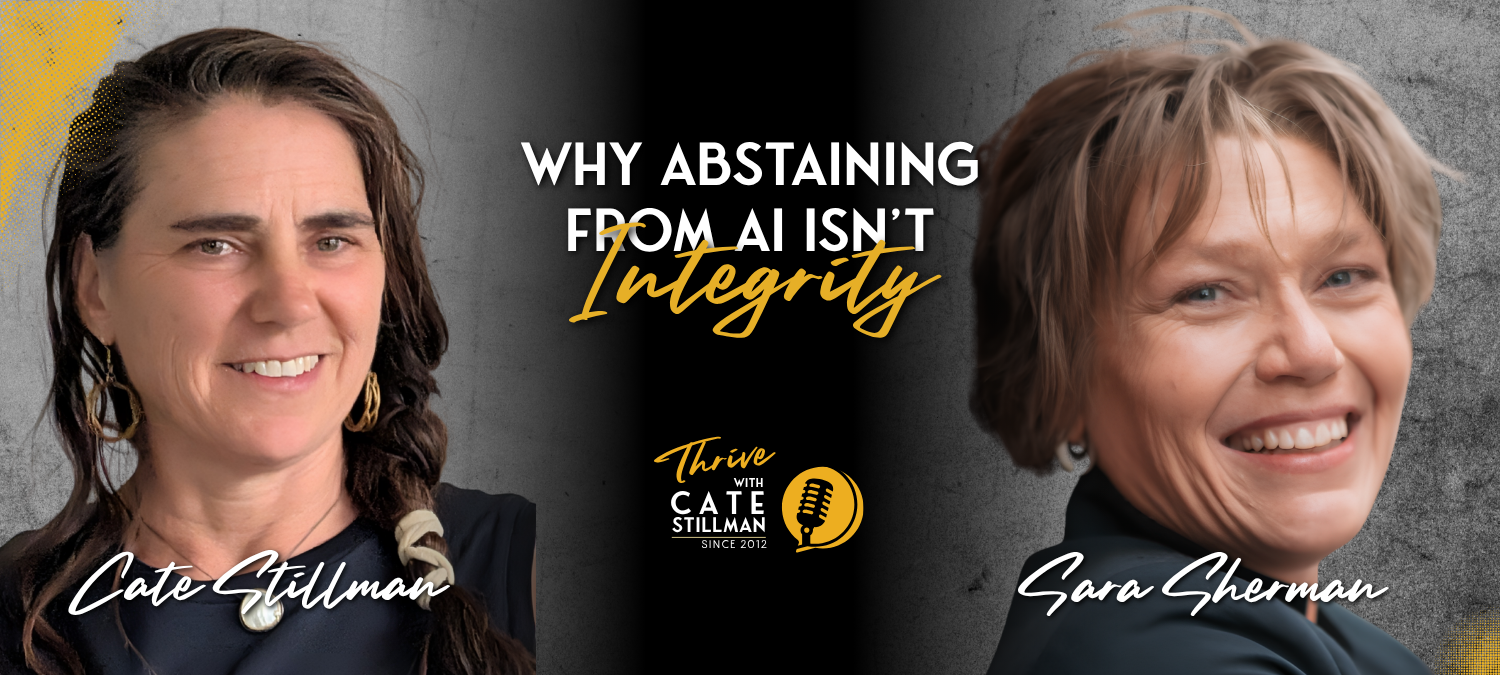
In this candid episode of the Thrive with Cate Podcast, Cate Stillman sits down with Sara Sherman — founder of Dandelion Family, therapeutic farm operator, equine-assisted coach, and Alex Hormozi Vantage mastermind member — for a real-time look at what it takes to rebuild a wellness business from the ground up using an AI operating system.
Sara opens up about the collapse most wellness pros never see coming: after 5 years of building her Medicaid-funded therapeutic practice in Minnesota from $200K to $1.3M in revenue (540% growth), state policy changes on May 18, 2025 wiped out her entire operating model overnight. She went from a team of 14 to herself, her husband, and a couple of part-time staff — with 21 families cut off from services through no fault of her own.
What she's built in the months since is remarkable: a virtual group coaching offering for parents of children with complex behaviors, powered entirely by an AI operating system Sara built herself using Claude Cowork, Claude Code, and the Terminal — with zero engineering background and a health condition that limits her screen time.
Cate mirrors the parallel arc: rebuilding Yogahealer into Club Thrive and Wellness Pro Academy with a Claude-based AI operating system for her small team. Together, they name the elephant nobody in the wellness world wants to talk about — the AI shaming quietly silencing the conscious voices that should be leading this technology.
This is a conversation for every wellness pro, coach, or holistic practitioner watching the AI revolution from the sidelines — and wondering if there's a way to lean in without losing their integrity.
What You'll Learn in This Episode
- How to rebuild a wellness business after a government contract collapse
- Why virtual group coaching outperforms one-on-one for both revenue and results
- Sara's Command Agent — the daily AI prompt that runs her entire business
- Where to start with Claude Cowork, Claude Code, and the Terminal as a non-engineer
- Why slop kills quality — and how constraints protect your mission
- The truth about AI shaming in wellness circles — and who benefits when conscious voices stay silent
- Why AI adoption requires the exact grit wellness culture claims to teach but often avoids
- How AI teaches visionary founders to uphold policy and honor the systems they build
From Prescott College to the Therapeutic Farm
Sara Sherman's path into human-animal healing didn't start with horses.
It started at Prescott College in Arizona — a non-traditional outdoor education school with a deep climate orientation — where Sara studied counseling psychology and equine experiential learning. The equine work became the doorway into what she really cared about: connection, the neurobiology of trust, and how animals mirror the parts of us we can't yet see in ourselves.
In 2017, Sara trained with Natural Life Manship and everything shifted:
"Once I understood the neurobiology of what I was doing with horses and people, I could be intentional about how to use it. And I could create curriculum. I could create really intentional processes for people to have."
That single reframe — from intuitive work to intentional neurobiological practice — became the spine of Dandelion Family, the therapeutic practice Sara runs with her husband Matt on their Minnesota farm.
The Medicaid Rocket — and the Overnight Collapse
For five years, Dandelion Family rode a rocket.
Sara's practice grew 540% — from just over $200K in revenue in year one to $1.3M in 2025. She built a team of 14 people. She was working primarily with children with complex behavioral needs, using group work as the intervention because the neuroscience is clear: community is the medicine.
And then, on May 18, 2025, it all ended.
"We went from a team of about 14 down to myself and my husband and a couple part-time people. 21 families — we shut the door on them overnight, not because we wanted to do that, but because of the legal implications."
Minnesota's Medicaid rules had shifted so many times over so many months that continuing to operate had become legally untenable. The state told her practice they couldn't do groups anymore — the exact modality the entire business model was built around. Staffing ratios changed. Reimbursement structures changed. The whole operating floor kept moving.
Sara is emphatic about one thing:
"We did not commit fraud. We were operating in a system that kept changing the rules. Anybody that owns a business or makes plans knows that when your entire operating system depends on something you can't manage or control in any way, it is dangerous and pretty terrifying."
The New Model: Virtual Group Coaching, Direct to Consumer
The rebuild had to happen fast. Cash was tight. Sara had to answer a question every collapsed wellness pro faces: What can I sell the fastest that still provides real quality?
Her answer: a virtual group coaching program for parents of children with complex behaviors.
The core problem she solves is deceptively simple:
"Challenged parents who have children with complex behaviors who don't want to be experts. They just want to feel like they're good parents."
The transformation:
- Before: Constant chaos, shame, isolation, self-doubt, rupture in relationship
- After: Belonging, a new set of expectations, a family rule book they design themselves — and enough acceptance of what is that behavior change actually happens
The virtual offer is the springboard. The bigger offerings — including the equine-based work — come later, once the internal capacity is rebuilt.
Building an AI Operating System with Zero Engineering Background
What Sara has built in the months since her collapse is the most quietly radical part of the entire episode.
Working alone, with a health condition that limits her screen time and neuroinflammation that compromises her thinking on hard days, Sara has built:
- A financial machine (multiple connected AI agents that do bookkeeping, projections, day-to-day snapshots, and week views)
- A video editor for long-form and short-form video
- A Command Agent — her daily operating prompt that pulls her top three priorities, financials, funnel status, and Asana updates every morning
- A curated intellectual property catalog — she asked Claude Cowork to scrape her Google Drive and collate every piece of curriculum, presentation, and training document she'd ever created
- Over 50 different builds in a single month
She did all of this using Claude Cowork, Claude Code, and the Terminal — with no prior engineering experience.
"I birthed an engineer. I remember watching my son study and I'd look at his screen and think, 'What in the world is that?' It's a totally different language. And I never wanted to participate in that. In the face of desperation, I had to figure some stuff out really quick."
The Command Agent — A Daily AI Operating Prompt
Of everything Sara has built, the Command Agent is the piece most wellness pros can immediately learn from.
Before Sara opens any other thread in Claude, before she starts a new build, before she does anything reactive — she opens her Command Agent. It's her guardrail against her own natural pattern (visionary, over-generator, quick-start).
The Command Agent tells her:
- Her top three to-do items for the day
- A rundown on her finances
- An update on her funnel
- Integrated data from Asana, her CRM, her bookkeeping
Why does she need this? Because without it, she'd open eight threads at once and create conflict in the background that she'd spend days cleaning up.
"I was creating mess for myself to clean up. And so Command Agent is my guardrail to stay organized."
This is the practice most visionary founders are missing: the AI-generated constraint layer that protects your own attention from your own personality.
AI Shaming in the Wellness World
Halfway through the episode, Cate names the elephant most wellness pros are quietly navigating.
Inside conscious wellness communities, there's a growing wave of AI shaming — critique of energy use, of environmental impact, of "outsourcing" thinking, of losing embodiment. Much of it is well-intentioned. Some of it is coming from major media outlets like the New York Times and NPR that have amplified specific narratives about AI harm.
Cate's honest take, after cross-checking sources using Perplexity:
"The judgment is largely coming from the uninformed. You can't save the planet by abstaining. What the bigger companies are doing is on such a ginormous scale that your little tiny recycling over here isn't going to make any difference. Whereas if you use AI effectively for your cause, it could actually make a difference."
Sara names the deeper cost:
"All of the things that well-intended people abstain from in an effort to have an impact — when in fact coming from the inside and being knowledgeable is absolutely what gives you the power. It makes your voice louder."
Both women arrive at the same conclusion: the world needs conscious, wellness-oriented, socially-aware voices leading AI adoption — not abstaining from it. The uninformed are already using these tools at scale. The question is whether the wise are willing to build alongside them.
Slop vs. Integrity: The Overgeneration Problem
Sara names something every AI-forward creator eventually collides with — the slop problem.
When you can generate 50 builds in a month, most of them won't work. Quality suffers. AI-generated content that hasn't been curated feels flat, generic, off-brand. And integrity-first founders start to feel it in their gut before they can name it.
"I really did a hard stop. I had to get a handle on what was going on. That's why I built the Command Agent. I had to create guardrails for myself. I had to create an organizational structure within my operating system, within myself."
Cate names it back:
"It's so easy to be hyper-generative with AI. But then the slop — or where the quality is out of integrity with what we're actually trying to create — that's the big problem. So for those of us who create a lot, we run into that really quickly. And then we go back to the swing of the pendulum: I need to tighten the system, tighten the rules, operate within tighter constraints."
This is Systems Lord work — and it's exactly the growth edge that visionary creators most need.
Business as a Path to Enlightenment
Toward the end of the episode, Cate reframes the entire AI adoption journey through the lens of yogic and Ayurvedic philosophy.
In Ayurveda, healthy tissues uphold their own integrity — this is the meaning of Dharma. A body is healthy when each organ system holds its own function without collapsing into another's.
Cate applies this to business:
"When members come to me with unique cases, I'd break my own policy. But the point of the policy is that we have a policy. And you guys uphold it. And I refer everyone to you. So we get me out of these special exemption conversations where I keep changing the policy."
AI is teaching visionary founders to uphold their own systems. To create constraints and honor them. To stop rescuing and start upholding.
This is why Cate calls business her path to enlightenment: it teaches the hardest lessons about ego, integrity, and dharma more clearly than any meditation cushion.
Why This Matters Now
The wellness pros who lean into AI now — with integrity, constraints, and conscious purpose — will be the ones defining what this technology looks like for the next decade. Those who abstain out of fear or virtue signaling will find themselves increasingly unable to compete with the uninformed voices already scaling.
You don't need to become an engineer.
You need to be willing to open the Terminal, ask Claude to teach you as you go, and build one small guardrail at a time.
Your voice — the conscious one, the wellness-oriented one, the one grounded in years of embodied wisdom — belongs in this conversation.
Resources & Links
🌐 Dandelion Family (Sara's Practice) → dandelion-family.com
🐴 Natural Life Manship → naturallifemanship.com
🌿 Wellness Pro Academy → wellnesspro.academy
🧘 Yogahealer → yogahealer.com
Books by Cate Stillman:
- 📗 Body Thrive → https://amzn.to/3udNFR0
- 📘 Master of You → https://amzn.to/3OlfoGn
- 📙 Primal Habits → https://amzn.to/3OvfPOx
- 📕 Uninflamed → https://amzn.to/3UUBgJ2
Referenced in this episode:
- Alex Hormozi's Vantage Mastermind (on SKOOL)
- Ruben Hasid on Substack (AI newsletter for non-developers)
- Lenny's Newsletter on Substack
- Claude Cowork, Claude Code, Perplexity
- Company of One by Paul Jarvis
- Plaud (voice recorder for verbal processors)
- Kolbe A Index (quick-start vs. follow-through personality types)