The New Floor: How Ayurvedic Habits Unlock Your Dharma | Cate Stillman & Nina Pullella
About this episode:
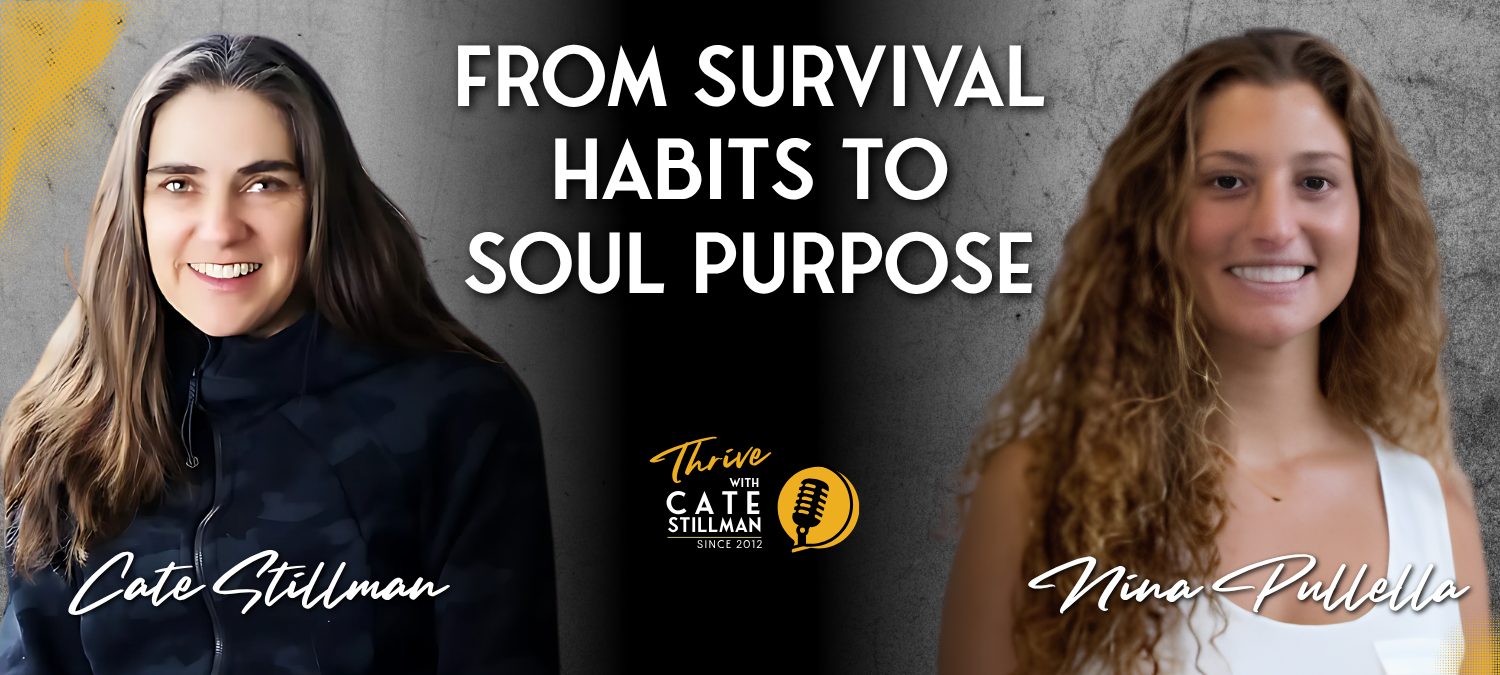
In this episode of the Thrive with Cate Podcast, Cate Stillman sits down with Nina Pullella — Ayurvedic practitioner, founder of Wild Woman Collective of Oahu, and Wellness Pro Academy member — for a live teaching session with the women of Nina’s community emerging from a month-long cleanse.
What follows is one of Cate’s most layered teachings: how dialing in circadian rhythm naturally pulls women toward Dharma, how habit stacking around a keystone habit unlocks identity evolution, and why the window right after a cleanse is the most important moment of your year.
Together, Cate and Nina bridge Ayurvedic embodiment, modern habit science, the four aims of life, and the Medusa myth — offering a grounded, empowering map for women ready to claim their New Floor.
This is a conversation about what happens after the cave.
What You’ll Learn in This Episode
- Why detox momentum is wasted if you don’t name your New Floor
- How the Four Aims of Life (Artha, Kama, Moksha, Dharma) sequence themselves through habit work
- The Keystone Habit — and how to find yours
- Why community heals faster than one-on-one care
- The Medusa map: cave, Kundalini, Pegasus, and the sword of Chrysor
- How to leverage past identities as building blocks for Future You
- The trade-offs and trade-ups that make the New Floor sacred
From Group Detoxes to the Body Thrive Method
Cate Stillman’s path into habit science didn’t start in a classroom.
It started by accident — by watching the same group of women in a small Idaho-Wyoming valley come through her twice-yearly detoxes for over two decades, and noticing something her advanced Ayurvedic training never taught her:
“It was really strange that the people that paid me more money and I did all this one-on-one work were getting healthy at the same pace as the detoxers.”
Same protocols. Same circadian rhythm. Same diet shifts. Same breath work.
But the people in the group container outpaced the people in private care.
That single observation — across 24 years and hundreds of participants — became Body Thrive, then Master of You, then Club Thrive, and the spine of everything she now teaches inside Wellness Pro Academy.
The pattern?
Community is the medicine.
The Four Aims of Life — and Why Dharma Is the One That Drives the Rest
In Ayurveda and yoga philosophy, there are four aims of human life — the Purushartha:
- Artha — material support, “having enough stuff”
- Kama — pleasure, sensual fulfillment
- Moksha — liberation, inner peace, dropping into the ground of being
- Dharma — purpose, the unique trajectory of this lifetime
Cate’s insight from working with hundreds of women dialing in circadian rhythm habits?
The first three boxes get checked almost automatically once Dinacharya is in place.
Modern materialism over-supplies Artha. A regulated nervous system delivers Kama. Brief daily silence and rhythm-aligned living open the door to Moksha. But Dharma — purpose — remains the question that pulls women forward.
“Dharma drives Artha, Kama, and Moksha. The peace I get to experience, the enlightenment I get to experience, is a direct reflection of people telling me, ‘Meeting you is a life-changing experience.'”
When the first three aims are checked, the question stops being “How do I feel better?” and becomes “What am I here to do?”
The Keystone Habit — Find the One That Makes the Others Easy
Most habit programs ask you to change everything.
Cate’s framework asks one question: What’s the one habit that, if I do it, makes every other habit easier?
For Cate, after years of testing? Early to bed.
When she goes to bed early, she naturally wakes before dawn. She hydrates. She eliminates. She does breath-body practices. The whole Dinacharya cascade activates from one upstream decision.
For others in the community, it’s different:
- For some, breath-body practices are the keystone
- For others, meal spacing unlocks everything
- For some, easeful living itself is the upstream habit
- For others, just sitting in silence for two minutes a day is the lever
The point isn’t to follow Cate’s keystone. It’s to find your own.
Master of You — The Five-Element Life Design Framework
Once Dinacharya is in place, Cate’s second book Master of You maps the architecture of a multidimensional life through the five elements:
- Earth (Body) — the Body Thrive habits, your physical foundation
- Fire (Vision) — what you’re building toward in 1–3 years
- Air (Time) — strategy, how you allocate your hours
- Ether (Space) — your environment, which silently dictates which habits are easy
- Water (Flow) — currency, accumulation, and how you move through your days
The element most women underestimate?
Ether — your space.
“Whenever you’re wondering why a habit is hard, just reshape your space. Architect your space to preference the habits that you want to have. That’s the easiest way to change your habits.”
Reorganize the fridge. Redo the spice drawer. Move the analog clock into the bedroom. Take the phone out. The environment becomes the silent coach.
Why Community Heals Faster Than One-on-One
This is the insight that quietly built Wellness Pro Academy.
For years, Cate ran a high-end one-on-one Ayurvedic practice — personalized diets, hand-mixed herbal formulas, private bodywork, lifestyle prescriptions tailored to each constitution.
And it worked.
But twice a year, she ran group detoxes for 30+ people at a time — same general protocol, lighter touch.
“The people I was working with one-on-one weren’t doing nearly as well as the group detoxers. And they were paying me more money.”
What the group container offered that one-on-one couldn’t:
- Normalization (everyone going to bed early, so no one feels weird)
- Permission (everyone struggling with the same things)
- Accountability without surveillance
- Witness to identity-level shifts in others
- A shared timeline of transformation
This is the foundation of Cate’s club model — and the exact spine Nina Pullella now uses to lead Wild Woman Collective.
The Medusa Map — What Happens After the Cave
Halfway through the episode, Cate offers a teaching that doesn’t show up in habit books — the Medusa myth as a map for post-detox evolution.
Most people know the surface story: Medusa was raped in Athena’s temple, blamed by Athena, and turned into a snake-haired monster whose gaze turned men to stone.
What most people miss is what came after.
Medusa retreats to the cave. She tames her Kundalini. She builds her own altar — not Athena’s. She moves from being a victim of the temple to being sovereign in her own practice. This is Svadhyaya — self-study, self-wisdom.
When she’s eventually beheaded by Perseus, two beings emerge from her neck:
- Pegasus — the winged horse, organized prana, energy now lifted and directed
- Chrysor — the golden sword, the discernment that cuts the 80 from the 20
For Cate, this is the map of any meaningful detox:
- The temple (modern culture) didn’t work
- The cave (cleanse) is where you tame your own energy
- Pegasus is the organized vitality that emerges
- Chrysor is the sword you need next — the discernment to name what 80% of your old identity must be released
The post-detox window is the sword moment.
The New Floor and the Old Floor
This is the framework Cate uses with her women’s communities — and the one Nina now teaches inside Wild Woman Collective.
The New Floor is your emerging identity. The habits, standards, relationships, and rhythms you’re growing into.
The Old Floor is what must be honored and released so the New Floor can land.
“We make the new floor sacred. The old floor is the sacrifice.”
This isn’t about deprivation. It’s about discernment.
Cate shares her own example: for most of her career, she avoided detailed financial administration in her business. She called herself a creative, not an accountant. After processing trauma out of her nervous system, she finally faced the avoidance — got intimate with every number, every vendor, every margin.
The result?
“All of a sudden I had such an elegant business in my 50s. My finances are tight. I can bonus my people. My nervous system got re-regulated.”
The Old Floor: “Just make more money and don’t worry about it.”
The New Floor: Finance-Pro Cate. Elegant business. 60+ ski days a year. 60+ surf days a year.
The 80/20 was named. The sword was used. The new identity arrived.
Trade-offs and Trade-ups
The most actionable practice from this episode is also the simplest:
For every Old Floor habit you’re naming, identify:
- The trade-off — what you’re consciously letting go of
- The trade-up — what becomes possible when you do
The community offers their answers live:
- Jenna: Old floor — emotional eating. Trade-up — freedom and peace, lightness, presence
- Brianna: Old floor — skipping creative and nature time for work. Trade-up — going to bed earlier so morning creative time is non-negotiable
- Nalani: Old floor — reading on iPad before bed. Trade-up — real books, deeper sleep, vivid dreams, energy for ocean swims
The pattern: each woman’s specific Old Floor unlocks a specific 3-year future when named clearly.
Why This Matters Now
The post-detox integration window is the most underutilized moment in modern wellness.
Most women finish a cleanse, feel proud, and slowly slide back into the same patterns within weeks. Not because they’re weak — but because no one taught them what to do with the momentum.
This episode is that teaching.
- Name your New Floor before you go to bed tonight
- Identify your Keystone Habit
- Choose one Trade-off and one Trade-up
- Give your emerging identity a moniker — make it silly, make it specific
- Honor the past identities that built you here — they were the building blocks
Resources & Links
🌐 Nina Pullella — Wild Woman Collective of Oahu
🌿 Wellness Pro Academy → wellnesspro.academy
🧘 Yogahealer → yogahealer.com
Books by Cate Stillman:
- 📗 Body Thrive → https://amzn.to/3udNFR0
- 📘 Master of You → https://amzn.to/3OlfoGn
- 📙 Primal Habits → https://amzn.to/3OvfPOx
- 📕 Uninflamed → https://amzn.to/3UUBgJ2
- 📓 Rewilding Medusa (forthcoming)
Referenced in this episode:
- Dan Sullivan / Strategic Coach on leveraging past for future
- Pareto’s Principle (the 80/20 rule)
- Purushartha (the four aims of life in Ayurveda and yoga)