The Silent Epidemic Killing Men Under 50 — And How to Fix It
About this episode:
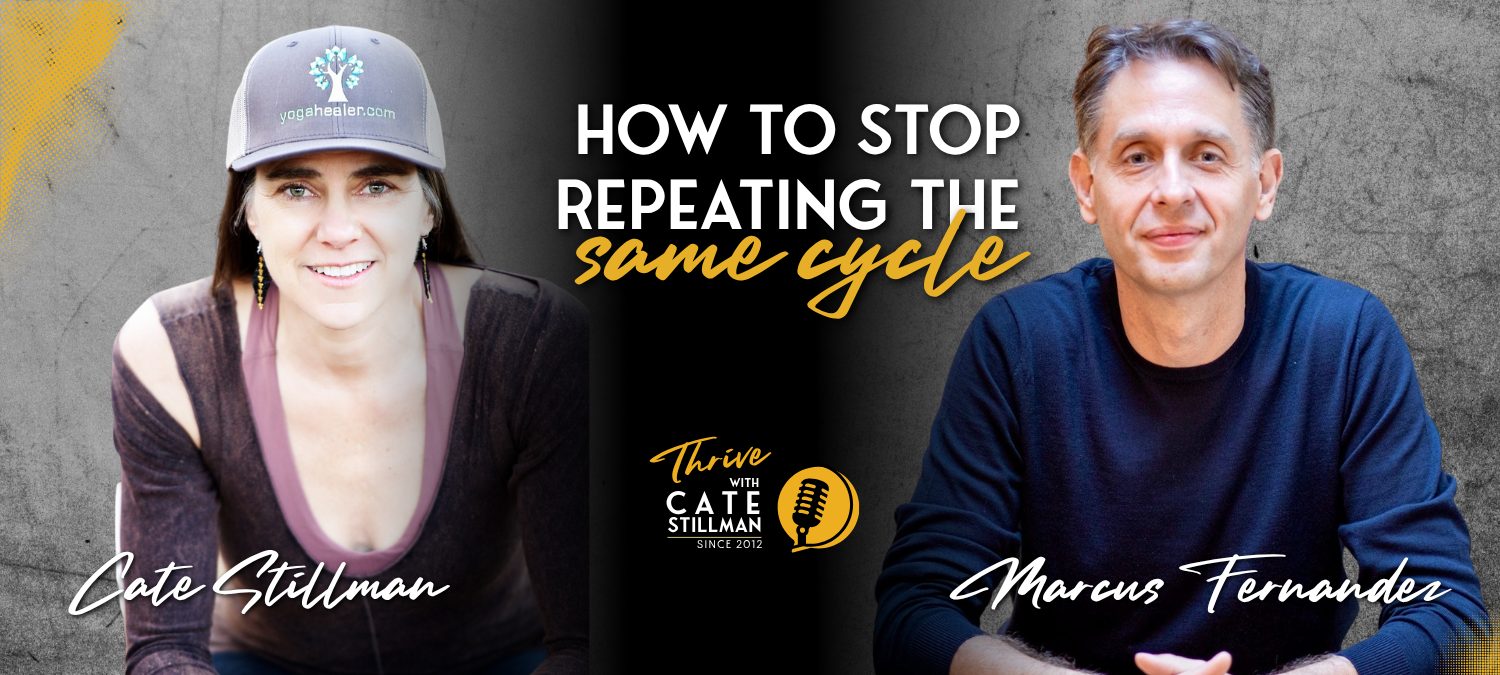
In this episode of the Thrive with Cate podcast, Cate Stillman sits down with Marcus Fernandez — homeopath, educator, author of Homeopathy at Home, and host of Beyond the Shed — to explore what women between 35 and 70 truly need to know about the men in their lives.
From suppressed emotion and Gen X conditioning to the silent epidemic of male suicide, Marcus shares why “it’s always the women who bring the men” into wellness — and how families can shift the pattern before a heart attack, divorce, or crisis forces the conversation.
Together, Cate and Marcus bridge homeopathy, masculine psychology, generational healing, and practical lifestyle design — offering listeners a grounded, compassionate roadmap for understanding men’s emotional and physical health.
This is a conversation about reaching the men we love before life does.
What You’ll Learn in This Episode
- Why suppressed emotion lands Gen X men in cardiology wards
- The MEDS Framework: Meditation, Exercise, Diet, Sleep
- How to create a 2-minute transition ritual between work and home
- Why male suicide is the #1 killer of men under 50 — and why nobody’s talking about it
- How phone addiction is wrecking men’s sleep, hormones, and presence
- Why Gen Z boys are starving for genuine male mentorship
- The “Cave & The Shed” — and why men retreat (and why it’s healthy)
- How human connection is becoming the ultimate antidote to AI overwhelm
From Cardiology Wards to Beyond the Shed
Marcus Fernandez’s path into men’s health didn’t start in a podcast studio.
As he shares with Cate:
“I used to work in a cardiology ward when I was training as a homeopath because I wanted to see both sides of medicine. So many men who’d come in like my age now — heart attack — and I’d find them sometimes just breaking down upset behind the curtains.”
Those moments shaped 30 years of clinical practice. After founding the Centre for Homeopathic Medicine in London and writing Homeopathy at Home, Marcus co-created Beyond the Shed — a podcast space where men finally talk about the things they’ve been carrying in silence.
His method isn’t about fixing men.
It’s about creating the right environment for them to be human.
“Once you get men in the right environment, they will talk and they will express themselves.”
A Heart Attack Is a Heart Breaking
One of Marcus’s most powerful reframes is also his simplest:
“What’s a heart attack? It’s like the heart breaking. All that emotion that was behind it — these really tough guys just kept it in, kept it in, and then something physically happens.”
Through the lens of mind-body medicine, Marcus traces how suppressed grief, disappointment, and unspoken love accumulate in the chest. The lungs hold grief. The liver holds anger. The gallbladder holds bitterness.
Men of a certain generation, he explains, were never given language for any of it.
The result?
Emotional pressure that has nowhere to go — until the body forces the conversation.
Why Men Don’t Speak
Cate names something many women have felt: men who want to express love but seem unable to access it.
Marcus confirms this is common:
“My wife says, ‘Why don’t you say that you love me?’ And they say, ‘I want to, but I just feel numb. I know I love her, but I can’t say it. It’s stuck in here.'”
This isn’t a lack of love.
It’s a lack of permission.
Generations of “be strong, be tough, don’t cry” conditioning created men with full hearts and locked throats.
The healing?
Not therapy alone. Not lectures from spouses.
But environments — like sheds, gyms, soccer fields, podcasts — where men finally feel safe enough to crack open.
The MEDS Framework
Marcus’s clinical answer to “where do I start?” is deliberately uncomplicated.
M — Meditation or Mindfulness: Five minutes. Call it prayer, contemplation, or breathwork. The label doesn’t matter.
E — Exercise & Movement: Especially strength training for midlife men. Sitting is the new smoking, and the prostate pays the price.
D — Diet & Nutrition: “If your grandmother would recognize it, it’s real food.” Aim for 80% real, allow 20% flexibility.
S — Sleep: The cornerstone of everything. No phones in the bedroom. No screens before bed. Bedroom as sanctuary.
“It doesn’t have to be expensive. There’s many things you can do where you just stimulate the body to heal itself — and it knows what to do.”
The Driveway Ritual
One of the most actionable tools Marcus shares is a simple transition practice for men coming home from work.
Park the car.
Before walking inside, do box breathing: inhale for 4, hold for 4, exhale for 4, hold for 4.
Repeat for 2 minutes.
Why?
“Your kids want you to be present. They want you to be present, which is so, so, so crucial.”
Marcus recalls his own moment of recognition — his 2-year-old son repeatedly closing his laptop, not to be naughty, but to call him home. To be here.
The driveway ritual isn’t biohacking.
It’s becoming a father at the threshold.
The Silent Epidemic
The conversation takes a sobering turn when Marcus shares the statistic that launched Beyond the Shed:
“The biggest cause of death of men under the age of 50 in the UK is suicide. And nobody’s talking about it.”
The same is true in the US.
Many “accidents” are quiet exits.
Marcus describes how this realization — combined with watching his own son turn 13, the same age Marcus was when his father left — pushed him to build a literal shed in London, fill it with tools and microphones, and invite men in to talk.
What’s emerged?
Tears. Anger. Father wounds. Son guilt. Stories of incarceration, cancer diagnoses, divorce, and quiet redemption.
And the biggest fans of the podcast?
Women.
“Women have said to me, ‘I’ve learned more about men listening to this than I have in 20 years with my husband.'”
What Young Men Are Starving For
Cate and Marcus turn to Gen Z — and find an unexpected hopefulness.
This generation isn’t drinking like Gen X did. They’re not following authority blindly. They’re skeptical of pharmaceutical agendas, processed food, and corporate narratives.
But they are starving for one thing:
Genuine male mentorship.
Marcus describes watching his son’s soccer team light up when their coach says “well done, lads.” A small acknowledgment from a respected man lands like sunlight.
“They are looking for that male role model. They’re looking for mentorship — mentally, emotionally, on all those aspects.”
When society fails to provide it, boys find it elsewhere — sometimes in destructive places.
The opportunity?
Show up. Mentor. Acknowledge. Be the man young men are quietly searching for.
The 56-Year-Old Crisis
Marcus identifies a clinical pattern he sees again and again: men around 56 hitting a wall of disappointment.
“This is not how I thought life would turn out for me.”
He connects this to seven-year cycles, Saturn returns, and the ancient Indian framework of Vanaprastha — the third stage of life when one retreats from worldly obligations to discover the self.
Cate notes that yoga and Qigong were originally designed for exactly this stage — for people who’ve tasted what the world offers and are ready to turn inward.
The midlife crisis, in this light, isn’t pathology.
It’s an invitation.
Sleep, Phones & Sanctuary
Marcus is unsparing about phones in the bedroom.
“Where’s your cell phone? ‘It’s under my pillow.’ Why? ‘In case I have an emergency.’ How many emergencies have you had in six months? ‘None.'”
His prescriptions are simple:
- Phone out of the bedroom (in the hallway is fine)
- Switch your phone to grayscale — it kills the optical pull
- No screens 1–2 hours before bed
- Don’t eat 2–3 hours before sleep
- Bedroom = sanctuary. No work. No TV. No electric blankets.
For deeper biohacking, Marcus uses an Eight Sleep mattress that regulates temperature based on biorhythms.
But the core message stays grounded:
“You don’t need expensive supplements. You just need to take responsibility — small things consistently.”
Cold Therapy & The Cheapest Biohack
Marcus shares a story of a deeply depressed client he prescribed only one thing: a 60-second cold shower.
By day three, the client texted: “I feel amazing.”
Cate adds her own story — using cryotherapy through cancer treatment and recovering from hip replacement by walking in 40-degree Montana lake water.
The takeaway?
The most powerful tools are often free.
Cold. Sun. Breath. Movement. Connection. Sleep.
Spirituality Meets Practicality
What makes this conversation land is its refusal to moralize.
Marcus isn’t anti-pharmaceutical. He isn’t anti-modern. He’s pro-human.
“The pharmaceutical industry is not in the wellness business — it’s in the sickness business. That’s fine. But it doesn’t mean you have to be part of it. Your body has the most tremendous capacity to heal.”
Real wellness, in his view, is about agency.
About knowing yourself.
About being present with the people you love.
Why This Matters Now
As Cate reflects, the cultural pendulum is swinging back toward human connection.
AI is generating noise. Social media is generating surface. Younger generations are craving real-life experience, kinesthetic learning, and structured collaboration.
The future of wellness isn’t more apps.
It’s more presence.
More sheds. More circles. More driveway breaths.
More men finally allowed to be human.
Resources & Links
🌐 Marcus Fernandez’s Website: marcus-fernandez.com
🎧 Podcast: Beyond the Shed
📘 Book: Homeopathy at Home by Marcus Fernandez
🏛️ Centre for Homeopathic Medicine (London)
📖 Men Are from Mars, Women Are from Venus by John Gray
📖 Deep Work by Cal Newport
🌿 Wellness Pro Academy → wellnesspro.academy
🧘 Yogahealer → yogahealer.com
Books by Cate Stillman:
📗 Primal Habits → https://amzn.to/3OvfPOx
📘 Uninflamed → https://amzn.to/3UUBgJ2
📙 Body Thrive → https://amzn.to/3udNFR0
📕 Master of You → https://amzn.to/3OlfoGn